



Table of Contents
Charcoal Filter Rod Sourcing for Cigarette Manufacturers:
Cigarette manufacturers looking to add charcoal or activated carbon filter options to their product line face a more specialized sourcing decision than standard mono acetate filters require. This guide explains what a charcoal filter rod supplier and an activated carbon filter rod manufacturer actually provide, what to look for when evaluating potential partners, and how to assess a supplier’s readiness for bulk production orders, along with the practical questions worth asking before placing a large volume order.
Why Cigarette Manufacturers Are Sourcing Charcoal and Carbon Filter Rods?
Charcoal and activated carbon filter rods have become a meaningful category within global cigarette manufacturing, often positioned as offering a distinct smoking sensation and an additional stage of filtration compared to standard acetate filters. Demand for these formats has grown steadily as manufacturers look for ways to differentiate their product lines beyond flavor and packaging alone, particularly in markets where consumer awareness of filter type has increased.
For manufacturers considering this category for the first time, sourcing the right filter rod supplier is a more technical decision than it might initially appear, since charcoal and carbon filter rods involve additional material handling and production steps beyond standard acetate filter manufacturing.
What Is a Charcoal Filter Rod Supplier?
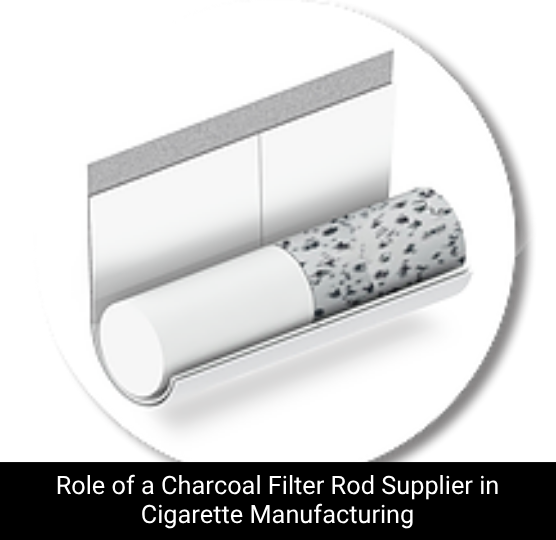
A charcoal filter rod supplier manufactures filter rods that incorporate a charcoal segment, typically combined with a standard cellulose acetate segment in what is known as a dual filter construction. The charcoal segment sits within the filter rod itself, positioned so that smoke passes through it as part of the overall filtration path.
Producing a consistent charcoal segment requires precise control over the amount and distribution of charcoal granules within the rod, since uneven distribution can lead to inconsistent filtration performance and variation in draw resistance across a production batch.
Read Our Article
Choosing the Right Cigarette Filter Rod ManufacturerWhat Is an Activated Carbon Filter Rod Manufacturer?
Activated carbon filter rod manufacturers produce filter rods using activated carbon rather than standard charcoal, a material processed to have a significantly higher surface area for adsorption. Activated carbon is generally regarded within the industry as offering more consistent filtration properties than standard charcoal, given its more controlled production process and particle uniformity.
Some manufacturers use the terms charcoal filter and activated carbon filter interchangeably in casual conversation, but from a production standpoint they involve different raw materials with different sourcing and handling requirements, which is worth clarifying directly with any prospective supplier.
What to Look for When Sourcing Charcoal or Carbon Filter Rods?
Evaluating a charcoal or activated carbon filter rod supplier involves many of the same fundamentals as sourcing any filter rod, along with a few considerations specific to this category.
- Consistency of charcoal or carbon segment placement across production batches
- Material sourcing transparency, including where the charcoal or activated carbon originates
- Production capacity to support the manufacturer’s target order volume
- Experience specifically with dual filter or charcoal filter formats, not only standard mono acetate production
- Sample batch availability for testing before committing to a full production order
 Drop Us an Email!
How Charcoal Filter Rods Are Manufactured?
Producing a charcoal filter rod typically involves forming two distinct segments, a cellulose acetate segment and a charcoal segment, and joining them together into a single finished rod. The charcoal segment itself is usually formed by blending charcoal granules with cellulose acetate tow at a controlled ratio, then processing this blend through the same forming machinery used for standard filter production, adapted for the additional material.
Maintaining a consistent charcoal to tow ratio across a production run is one of the more demanding aspects of this process, since variation in that ratio directly affects filtration performance and can also affect the structural integrity of the charcoal segment during high speed cigarette assembly.
How to Evaluate a Charcoal Filter Rod Supplier for Bulk Orders?
Manufacturers planning a bulk order of charcoal or activated carbon filter rods should request production samples ahead of time and test them under conditions that reflect their actual manufacturing line, rather than relying solely on a supplier’s general product descriptions. Segment placement consistency, charcoal distribution, and overall rod firmness are all worth verifying directly before committing to a large volume order.
It is also worth discussing a supplier’s capacity planning directly, since charcoal and carbon filter rod production can require different equipment scheduling than standard acetate filter runs. A supplier who can clearly explain their production capacity and lead times for this specific format is generally a lower risk partner for a bulk order than one who provides only general assurances.
Our Other Filters
Inner Shaped Filter Rods (Tube Filter Rods)What Are the Common Charcoal Filter Rod Configurations?
Charcoal filter rods are produced in several configurations depending on how a manufacturer wants to position the finished product. In a standard dual filter configuration, the charcoal segment sits adjacent to a cellulose acetate segment within a single filter rod. Some manufacturers request a longer charcoal segment for a more pronounced filtration effect, while others prefer a shorter segment paired with a longer acetate portion.
More specialized configurations combine a charcoal segment with a recessed air chamber or a capsule segment, creating a multi segment filter rod that requires more complex production coordination than a standard two segment dual filter. Manufacturers considering these more complex configurations should confirm a supplier’s specific experience with multi segment production before committing to a large order.
How Long Does It Take to Source Charcoal Filter Rods?
Lead times for charcoal and activated carbon filter rods are typically somewhat longer than for standard mono acetate filters, given the additional material handling and segment forming steps involved in production. Manufacturers should discuss realistic lead times directly with a prospective supplier rather than assuming charcoal filter production follows the same schedule as standard filter runs.
For manufacturers working with an export based supplier, total lead time should also account for shipping transit and any customs clearance requirements at the destination market, particularly for manufacturers sourcing charcoal filter rods for the first time from a new supplier.
What Quality Checks Apply to Charcoal Filter Rods?
Quality control for charcoal filter rods typically extends beyond the standard checks applied to acetate filters, since the charcoal segment introduces additional variables that need monitoring throughout production.
- Charcoal granule distribution and density within the charcoal segment
- Segment length consistency across production batches
- Overall rod firmness and structural integrity at the junction between segments
- Pressure drop consistency across the finished dual segment filter rod
 Call Us Now!
How Should Manufacturers Compare Charcoal Filter Rod Quotations?
When comparing quotations from different charcoal filter rod suppliers, manufacturers should look beyond the per unit price to understand exactly what is included in the specification. Two quotations at a similar price point can reflect meaningfully different charcoal content, segment length, or tow grade, all of which affect the finished filter’s performance even though the price difference alone would not reveal that.
Requesting a detailed specification sheet alongside any quotation, and comparing that specification against sample batches when possible, gives manufacturers a much more reliable basis for supplier comparison than price alone.
Is Charcoal Filtration More Effective Than Standard Filtration?
Charcoal and activated carbon filtration is often marketed as providing an additional layer of filtration compared to standard acetate filters, and the added material does interact with the smoke stream differently than acetate alone. However, the degree of additional filtration varies depending on the specific charcoal or carbon content, segment length, and overall filter design, so broad claims about charcoal filtration effectiveness should be evaluated specification by specification rather than assumed to be uniform across every charcoal filter product on the market.
For manufacturers, this means working closely with a supplier to understand exactly what a given charcoal or carbon specification delivers, rather than relying on general category assumptions when making product design and marketing decisions.
Frequently Asked Questions
What is the difference between charcoal and activated carbon filter rods?
Charcoal filter rods use standard charcoal granules, while activated carbon filter rods use carbon processed to have a higher surface area for adsorption, generally offering more consistent filtration properties.
How are charcoal filter rods manufactured?
Charcoal filter rods are typically formed by blending charcoal granules with cellulose acetate tow at a controlled ratio, then joining this segment with a standard acetate segment into a single dual filter rod.
What should manufacturers check before sourcing charcoal filter rods in bulk?
Manufacturers should request production samples, verify charcoal segment placement consistency, confirm material sourcing transparency, and discuss the supplier's production capacity and lead times for this specific format.
Are charcoal filters more effective than standard filters?
The degree of additional filtration depends on the specific charcoal content, segment length, and overall design, so effectiveness should be evaluated specification by specification rather than assumed to be uniform across products.
Sourcing Charcoal and Activated Carbon Filter Rods
Charcoal and activated carbon filter rods represent a distinct manufacturing category within cigarette filter production, requiring specific expertise in segment formation and material handling beyond standard acetate filter rods. Manufacturers evaluating suppliers for this category should prioritize demonstrated production consistency and transparent material sourcing over price alone, since these are the factors that most reliably predict a smooth long term production relationship.
Truewell Filter manufactures charcoal and dual filter rod formats alongside its full range of mono acetate, recessed, capsule, flavored, and shaped filter rods, applying consistent quality control across every production run for manufacturers worldwide.
Manufacturers exploring a charcoal or activated carbon filter product line for the first time are welcome to request sample batches and technical guidance to help determine the right segment configuration for their specific product goals. Reviewing a few sample configurations side by side is often the fastest way to identify which balance of charcoal content and segment length best fits a manufacturer’s target smoking characteristics before committing to a full production order.
Contact Truewell Filter today to learn more about our charcoal and activated carbon filter rod production, request samples, or discuss your bulk order requirements.