



How Truewell Filter supplies precision-engineered filter rods for heated tobacco products to manufacturers serving Indonesia, and what makes HTP filter design different from combustible cigarette filters.
Table of Contents
AI Summary
- Heated tobacco products (HTP) require filter rods engineered for heat-resistant performance, not just standard combustion filtration.
- Indonesia is one of the fastest-growing markets for filtered tobacco products in Southeast Asia, driving demand for reliable HTP-compatible filter components.
- Truewell Filter, based in Seoul, South Korea, manufactures and exports filter rods to manufacturers supplying the Indonesian market.
- HTP filter rods demand tighter tolerances on density, airflow, and thermal stability than standard mono acetate filters.
- Working with an export-ready supplier with documented material sourcing helps manufacturers avoid customs and compliance delays.
The Rise of Heated Tobacco Products in Southeast Asia
Heated tobacco products have moved from a niche category to a meaningful share of the tobacco market across several Southeast Asian countries. Indonesia, with one of the largest smoker populations in the region, has become a focal point for manufacturers evaluating where to introduce or expand HTP product lines. As consumer interest shifts toward reduced-combustion formats, the components inside these products, including the filter rod, take on a more technical role than they did in traditional cigarettes.
This shift creates a distinct sourcing challenge for manufacturers. Filter rods designed for standard combustible cigarettes are not simply transferable to HTP devices, since the operating conditions inside a heated tobacco stick are fundamentally different from a burning cigarette. Manufacturers entering or expanding in the Indonesian HTP category need filter partners who understand this distinction and can engineer accordingly.
 Email!
Why HTP Filter Rods Require Different Engineering
In a combustible cigarette, the filter rod manages tar, particulate matter, and draw resistance from a burning tobacco column. In a heated tobacco product, the tobacco is heated rather than burned, which changes the temperature profile, the composition of the aerosol passing through the filter, and the mechanical stresses the rod experiences during use.
This means HTP filter rods typically require tighter control over density and packing uniformity, so airflow and draw resistance stay consistent even under repeated heating cycles. Structural stability also matters more, since HTP sticks are handled differently by the heating device than a cigarette is by a lighter, and any inconsistency in rod firmness can affect how the product performs inside the device itself.
Material and Production Considerations
Because HTP filter rods interact with a heated aerosol stream rather than combustion smoke, the choice of tow material and its consistency becomes especially important. Truewell manufactures its filter rods using cellulose acetate tow with controlled specifications, maintaining the same production discipline across standard cigarette filters and HTP-oriented filter designs.
Production for HTP-compatible rods also benefits from precise crimping and forming control, since these rods are often produced at smaller diameters or in combination with other segments, depending on the design of the finished HTP stick. Consistency at this stage directly affects how the finished product performs on a manufacturer’s high-speed assembly lines.
Supplying the Indonesian Market from South Korea
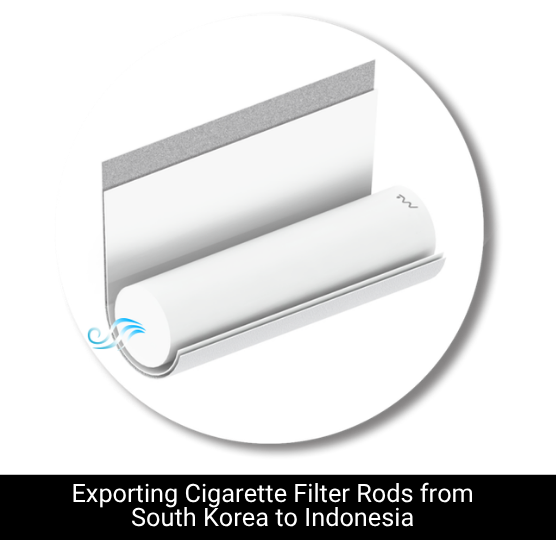
Truewell Filter is headquartered and manufactures in Seoul, South Korea. Truewell is not based in Indonesia and does not operate local production there; the company supplies filter rods to manufacturers serving the Indonesian market through export, supported by documented production processes and export-ready packaging and logistics.
For manufacturers sourcing filter rods for products destined for Indonesia, this distinction matters for planning purposes: lead times, shipping documentation, and customs paperwork are handled as part of an international supply relationship rather than a domestic one. Manufacturers working with Truewell should plan their sourcing timelines with export logistics in mind, and Truewell’s team supports this process directly rather than through a local Indonesian entity.
Quality Control for HTP-Oriented Filter Production
Given the tighter tolerances involved in HTP filter design, quality control checkpoints matter more than they might for standard filter rod runs. Truewell applies consistent checks on rod firmness, density, and dimensional accuracy across production batches, with the goal of giving manufacturers a filter component that performs the same way on batch one hundred as it did on batch one.
For manufacturers evaluating a new filter supplier for HTP products, it is worth asking directly about batch-to-batch consistency data, tow sourcing, and how a supplier documents production runs, since these are the details that tend to surface later as either a smooth production relationship or a recurring troubleshooting exercise.
How HTP Demand Is Reshaping Indonesian Manufacturing Plans
Manufacturers evaluating whether to add an HTP line for the Indonesian market are typically weighing three things at once: consumer appetite, regulatory direction, and the practical question of whether their existing filter-making equipment can handle a new rod specification without a costly retooling process. Filter rod diameter, segment structure, and packing density can all differ from a manufacturer’s existing combustible cigarette lines, which means the filter supplier’s ability to advise on compatible specifications, rather than simply filling an order, becomes part of the value they bring to the relationship.
This is one reason manufacturers moving into HTP for the first time often lean on a filter supplier’s engineering input early in the planning process rather than after a device design is finalized. Adjusting a filter rod specification after tooling decisions have already been locked in is a far more expensive exercise than accounting for it during initial planning.
Balancing Cost and Consistency in HTP Filter Production
Because HTP products are still a relatively premium category in most Southeast Asian markets, including Indonesia, manufacturers face a different cost calculation than they do with mass-market combustible cigarettes. Consumers in this category tend to be more sensitive to inconsistency in the product experience, since HTP devices are generally positioned as a more refined alternative to traditional smoking.
This puts additional weight on filter rod consistency, since even small variations in draw resistance or firmness are more likely to be noticed and to affect a consumer’s perception of product quality. Manufacturers sourcing filter rods for this category should weigh a supplier’s demonstrated consistency at least as heavily as unit price, since a slightly higher per-unit cost is often a reasonable trade-off against the risk of inconsistent product performance reaching the market.
Planning Lead Times for Export-Sourced HTP Filters
Because Truewell manufactures in South Korea and ships to manufacturers supplying Indonesia, lead time planning looks different than it would with a domestic supplier. Manufacturers should factor in production scheduling, shipping transit time, and customs clearance as three separate stages when planning their own production calendars, rather than assuming filter rod delivery will match the pace of a local supplier.
For manufacturers running seasonal promotions or planning a phased HTP product launch in Indonesia, building in buffer time around these three stages, particularly around customs processing, tends to prevent the kind of last-minute scramble that can delay a product launch date.
Questions Worth Asking Before Committing to an HTP Filter Supplier
Manufacturers evaluating filter suppliers for a new HTP line often focus their initial questions on price and minimum order quantity, which are reasonable starting points but do not tell the full story. It is worth also asking how a supplier tests for thermal stability, what data they can share on rejection rates from past HTP-oriented production runs, and how quickly they can turn around a revised specification if initial samples do not perform as expected on a manufacturer’s own assembly line.
A supplier that can answer these questions with specific, documented examples rather than general reassurance is usually a better indicator of how a production relationship will actually go once real order volumes are involved, rather than during an initial sampling phase where extra attention is naturally given to a new prospective customer.
 Call Us Now!
About Truewell Filter
Truewell Filter is a Seoul, South Korea-based manufacturer of cigarette filter rods, producing mono acetate, dual, recessed, capsule, flavored, and shaped filter rod designs for tobacco manufacturers worldwide. The company combines experience across filter production, materials, and machinery to support both standard and custom filter rod requirements.
Truewell supplies manufacturers across Asia, the Middle East, Europe, Africa, and Latin America, with export-ready packaging and documentation designed to support smooth international shipping and customs processes.
Frequently Asked Questions
Does Truewell manufacture filter rods inside Indonesia?
No. Truewell manufactures its filter rods in Seoul, South Korea, and exports to manufacturers who supply the Indonesian market. Truewell does not operate local production facilities in Indonesia.
What makes a filter rod suitable for heated tobacco products rather than standard cigarettes?
HTP filter rods generally require tighter control over density, airflow consistency, and structural firmness, since the product is exposed to a heated aerosol stream and handled differently than a combustible cigarette during use.
Can Truewell produce custom filter rod specifications for HTP products?
Truewell works with manufacturers to develop filter rod specifications suited to their specific HTP device and product design, adjusting factors such as density, diameter, and segment structure as needed.
What documentation does Truewell provide for export shipments?
Truewell supports manufacturers with export-ready documentation and packaging intended to help shipments move smoothly through customs and logistics processes for international buyers, including those supplying Indonesia.