



Table of Contents
Recessed vs. Traditional Cigarette Filters: A Comparison for Brand Success
The tobacco manufacturing industry has evolved significantly in the last two decades and one of the most debated product decisions brands face today is the choice between recessed filter rods and traditional filters. This is not merely a technical preference – it is a brand-positioning, regulatory and consumer-experience decision that directly shapes how your product performs in competitive markets.
Recessed Filter Rods: What Sets the Design Apart from Conventional Options
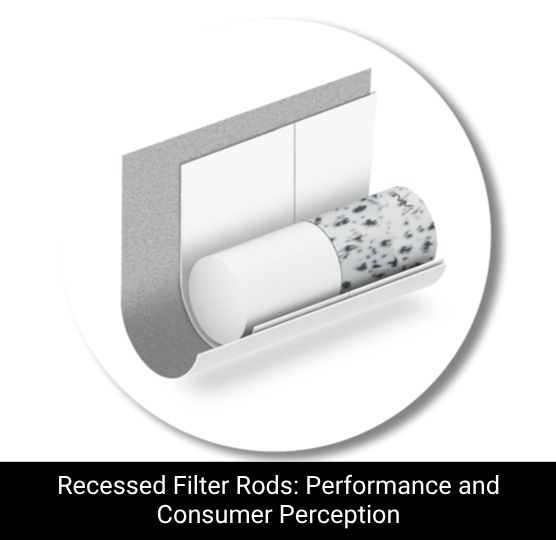
Recessed filter rods feature a filter element positioned slightly inward from the tip of the cigarette, creating a small air gap or cavity at the mouth end. This structural variation changes how the smoker interacts with the product from the first draw. Unlike a traditional filter that sits flush with the tobacco rod, a cigarette recessed filter rod adds a defined space that affects airflow, draw resistance and even the tactile experience of the product.
Traditional filters, by contrast, are flush-tip constructions – the filter material is exposed directly at the mouth end with no gap or cavity. They have been the industry standard for decades and remain dominant in high-volume, mass-market cigarette production.
 WhatsApp Us
Recess Cigarette Filter Rod Manufacturing: How the Construction Process Differs
A recess cigarette filter rod involves additional engineering steps during the filter-making process. The rod must be assembled so that the filtration material is inset to a precise depth, maintaining consistency across thousands of production units. Truewell Filter, as leading recessed filter rod manufacturer, achieving that dimensional accuracy at scale requires controlled production environments and rigorous quality benchmarks.
Traditional filter rod manufacturing is comparatively straightforward – the acetate tow or other filtration material is bonded, wrapped and cut to length without the inset positioning step. This simplicity translates to faster production cycles and lower per-unit costs. However, it also means fewer opportunities to differentiate the product on the shelf or in the hand.
Recess Filter Rod Performance: Draw Resistance, Airflow and Consumer Perception
The performance gap between a recess filter rod and a standard flush-tip filter is most evident in draw characteristics. The cavity at the tip of a recessed filter creates a pre-chamber effect that can moderate airflow, offering a smoother or more controlled draw depending on the cavity depth and internal geometry.
Consumer perception studies in mature tobacco markets have consistently shown that smokers associate a more deliberate draw with higher product quality. Brands using recessed filters have capitalised on this perception to justify a premium price point without changing the core tobacco blend. In markets where differentiation is difficult due to plain packaging laws or category saturation, even subtle physical cues like the filter cavity can influence repeat purchase behaviour.
Recessed Charcoal Filter: When Functional Filtration Meets Structural Design
One area where the recessed format clearly outperforms the traditional approach is in the integration of functional filtration media. A recessed charcoal filter combines activated carbon within the inset filter cavity, enabling the activated charcoal to interact with the smoke stream in a more contained, controlled manner.
In a flush-tip filter, charcoal granules are typically embedded within the acetate tow, which limits their effectiveness as the smoke passes through too quickly for maximum adsorption of volatile compounds. The recessed cavity design allows for better contact time between the smoke and the filtration media, making this an important consideration for brands seeking to market reduced-irritant or enhanced-filtration cigarettes to health-conscious segments.
Our Other Filters
Flavored Filter RodsCigarettes with Recessed Filter: Consumer Trends and Market Positioning
Cigarettes with recessed filter designs have seen growing adoption across premium and super-premium segments in markets such as South Korea, Japan, Western Europe and select Middle Eastern regions. The design signals craftsmanship and intentionality – qualities that resonate with smokers who are willing to pay more for a perceived upgrade in smoking experience.
From a brand architecture perspective, introducing a recessed filter variant allows manufacturers to create line extensions that visually and functionally stand apart from their standard range. This is particularly valuable in brand families where the core offering has become commoditised.
Traditional filter cigarettes continue to dominate volume-driven markets, particularly in price-sensitive segments across South and Southeast Asia, Eastern Europe and parts of Africa. For brands operating in these categories, the incremental manufacturing cost of a recessed design may not align with margin targets – making traditional filters the more practical choice.
Cigarette Recessed Filter Integration: What It Means for Brand Identity
When a brand integrates a cigarette recessed filter into its product design, it is making a statement about its positioning. The visible cavity at the tip – even when subtle – communicates a considered design process. This is not a cosmetic change; it is an engineering choice that shapes the entire sensory interaction the consumer has with the product.
Brands working with Truewell Filter benefit from a manufacturing partner that understands both the technical precision required for recessed cigarette filter rod construction and the commercial rationale behind it. The ability to produce consistent, high-quality recessed filter components at scale determines whether a brand can deliver on the premium promise it makes to consumers.
Our Other Filters
Outer shaped Filter RodsTraditional vs. Recessed Filters: Which Format Aligns with Your Production and Brand Goals?
Choosing between the two formats depends on several intersecting factors: your target consumer, price tier, production capacity, regulatory environment and long-term brand strategy.
If your brand operates in the mid-to-premium range and competes on product experience rather than price alone, recessed filter rods offer a tangible point of differentiation. The design supports higher retail pricing, premium packaging narratives and functional filtration enhancements such as the recessed charcoal filter configuration.
If your brand competes primarily on volume, accessibility and price parity, traditional filters remain the more viable option. Their manufacturing efficiency and lower component cost support the margins needed in high-volume, low-margin market conditions.
For brands navigating both ends of the spectrum – managing a portfolio that spans economy to premium – a hybrid strategy makes sense. Truewell Filter works with multi-tier tobacco manufacturers to develop filter specifications suited to each product line, ensuring that recessed filter components are applied where they generate the most brand equity.
 Email Us Today!
Conclusion
The debate between recessed filter rods and traditional filters ultimately comes down to brand intent. Traditional filters win on efficiency and cost; recessed filter formats win on differentiation, consumer experience and premium positioning. As the global tobacco market continues to fragment along quality and experience lines, choosing the right filter format is increasingly a strategic decision – not just a production one. Partnering with a Truewell Filter, as a reliable cigarette manufacturer ensures that whichever format you choose, it is executed with the precision your brand demands.