



Table of Contents
Recessed Filter Rod Production for Global Tobacco Markets: Quality Standards
The global tobacco industry operates under increasingly stringent production standards and the recessed filter segment is no exception. As consumer preferences evolve and regulatory frameworks tighten across key markets, manufacturers supplying recessed cigarette filter rods must demonstrate precision at every stage – from raw material sourcing to final dimensional inspection. For brand owners and OEM cigarette producers, understanding how these quality benchmarks are defined, measured and enforced is essential when evaluating suppliers and selecting the right filter partner.
 Email Us
Recess Filter Rod: How the Design Defines the Quality Baseline
A recess filter rod incorporates a controlled hollow cavity at the mouth end of the filter, created by recessing the acetate tow segment inward from the tipping paper line. This structural feature is not decorative – it directly governs airflow, heat insulation and the tactile smoking experience. The depth and diameter of this recessed cavity must be maintained within tight tolerances across every production run. Any deviation in cavity depth affects draw resistance, which in turn impacts compliance with international pressure drop specifications such as those outlined under ISO standards. Manufacturers who supply cigarettes with recessed filter designs to regulated markets must treat cavity dimensional accuracy as a primary quality indicator, not a secondary cosmetic parameter.
Recessed Filter Cigarette Tubes: Material Specifications That Drive Market Acceptance
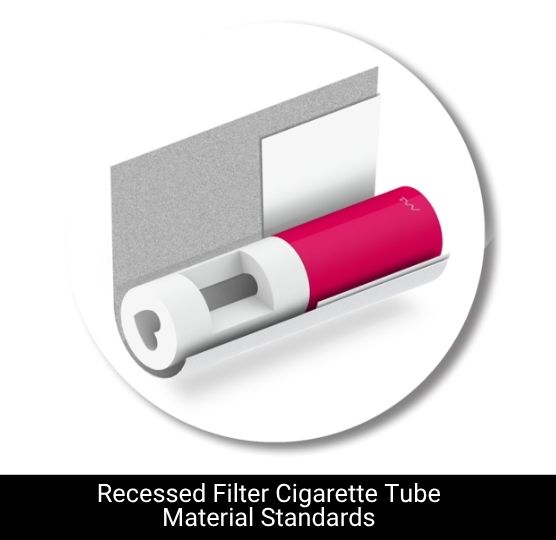
The structural integrity of recessed filter cigarette tubes depends heavily on the grade of cellulose acetate tow used and the plasticizer-to-tow ratio applied during rod formation. High-denier tow with consistent crimp frequency produces a firm rod body with stable cavity retention under compression during packing and transit. Low-quality tow tends to collapse the recess cavity, negating its functional purpose entirely. Beyond tow selection, the wrapping paper must maintain appropriate porosity levels to support ventilated filter constructions where applicable. For export-oriented production destined for markets in Europe, the Middle East and Southeast Asia, paper porosity must comply with regional tobacco product technical standards. Traceability of materials – including batch-level records of tow denier, plasticizer grade and paper porosity – forms the foundation of supplier qualification in global procurement audits.
Recessed Filters in Multi-Segment Constructions: Complexity and Quality Control
Many modern cigarette formats combine recessed filters with a secondary segment such as activated charcoal, flavored cellulose or a hollow tube. These multi-segment constructions introduce additional quality variables. Segment alignment between the recess cavity end and the adjoining filter element must be controlled during assembly, as misalignment causes inconsistent smoke delivery and visible defects in finished cigarettes. Adhesive application between segments must be uniform to prevent separation during high-speed cigarette making. Production lines handling recessed cigarette filter assemblies require in-line vision inspection systems capable of detecting cavity depth deviations, segment gaps and rod diameter variations in real time. Batch rejection rates for multi-segment recessed filter rods are typically higher than for mono acetate formats, making process discipline and automated inspection indispensable for export-grade quality.
Our Other Filters
Capsule Cigarette Filter RodRecessed Cigarette Filter: Regulatory Compliance across Global Markets
A recessed cigarette filter must comply with distinct regulatory requirements depending on the destination market. In the European Union, filter components are subject to traceability requirements under the Tobacco Products Directive and any filter material that could fragment and be ingested is subject to specific restrictions. In markets governed by WHO FCTC-aligned regulations, cigarette manufacturers sourcing recessed filter rods are increasingly required to disclose filter design characteristics in product notifications. In the United States, PMTA submissions for cigarettes with recessed filter configurations must include engineering data on filter ventilation, smoke chemistry impact and design intent. Suppliers who maintain documentation aligned with these regulatory frameworks – including material safety data, design drawings and production batch records – reduce compliance burden for their manufacturing clients and position themselves as preferred long-term partners in regulated markets.
Cigarettes with Recessed Filter: Market Demand Patterns and Production Volume Consistency
Cigarettes with recessed filter construction have seen consistent demand in premium and super-premium segments across Asia-Pacific, Eastern Europe and the Gulf Cooperation Council markets. The softer draw profile and cooler mouthfeel associated with the recessed cavity address consumer preferences for a less harsh smoking experience without requiring additional filtration chemistry. For manufacturers scaling production in these markets, the key quality challenge is not single-batch performance but run-to-run consistency across large production volumes. Pressure drop coefficient of variation must remain low across consecutive production shifts. Rod hardness uniformity, measured using standard rod firmness testers recommended method, must fall within the agreed specification window for every pallet shipped. Suppliers who invest in statistical process control and real-time production data logging are better positioned to sustain quality levels across the volumes demanded by international cigarette manufacturers.
Cigarette Recessed Filter: Inspection Protocols That Determine Export Readiness
The cigarette recessed filter inspection process at production level encompasses several critical checkpoints. Cavity depth measurement using calibrated probes or laser-based non-contact sensors ensures that each rod meets the agreed specification – typically defined in millimetres with tolerances of ±0.2 mm or tighter for premium applications. Rod circumference is measured at multiple points per batch to confirm dimensional consistency compatible with cigarette making machine mandrels. Pressure drop testing across filter rods is conducted per ISO using a defined set of test conditions, with results recorded for each production batch. Visual inspection lines equipped with high-speed cameras detect surface wrinkle defects, cavity collapse and contamination before rods are packed into export-grade containers. For global tobacco brands requiring third-party inspection, suppliers must facilitate access for pre-shipment audits aligned with SGS, Intertek or buyer-defined quality inspection protocols.
 Call Now!
Truewell Filter - Reliable Manufacturer & Exporter of Recessed Filter Rod
Truewell Filter, headquartered in Seoul, Republic of Korea, is a specialist manufacturer and exporter of premium cigarette filter rods with over 30 years of combined expertise across filter production, material development and cigarette manufacturing. The company supplies a comprehensive range of filter solutions – including recessed filter rods, dual filter rods, capsule filter rods, flavored filter rods and shaped filter rods – to cigarette manufacturers across Asia, the Middle East, Europe, Africa and Latin America. Guided by the principles of True Technology, True Quality and True Service, Truewell operates advanced production lines with real-time quality monitoring to ensure consistent, export-ready filter rod performance for global brand requirements.
Our Other Filters
Flavored Filter RodsConclusion
Quality standards in recessed filter rod production are defined not by individual parameters in isolation but by the consistency and traceability of every variable across the full production chain – from tow selection and cavity formation to regulatory documentation and pre-shipment inspection. As global tobacco markets demand tighter compliance and more transparent supply chains, manufacturers who embed quality systems at the process level rather than the inspection stage will lead in recessed filter rod supply. Brands sourcing these components must evaluate suppliers on documented process capability and regulatory alignment, not just on sample performance.