



Table of Contents
Advanced Filter Rod Systems: Managing Smoke Delivery and Airflow Behavior
The United States cigarette market is one of the most technically regulated and performance-driven environments in the global tobacco industry. Unlike markets that rely heavily on flavor novelty or visual differentiation, U.S. cigarette manufacturing prioritizes consistency, filtration efficiency, controlled draw resistance, and compliance with evolving regulatory frameworks. In this context, cigarette filter rod technology plays a central role in determining product performance, production stability, and long-term market viability.
As U.S. manufacturers continue to refine product portfolios, filter rods have evolved from basic acetate components into engineered systems that influence smoke delivery, tar management, airflow behavior, and consumer experience. Advanced cigarette filter rod technologies now support a wide range of product strategies—from standard, high-volume cigarettes to low-tar, premium, and export-oriented variants.
The U.S. Cigarette Market: Performance and Compliance as Core Drivers
The U.S. market places strong emphasis on predictable smoking characteristics and repeatability. Cigarette brands operating in this environment must ensure that every product delivers consistent pressure drop, stable filtration, and uniform draw resistance across large production volumes. Any variability can affect consumer perception and regulatory standing.
Regulatory scrutiny in the United States has further increased the importance of filter-based engineering. Rather than relying solely on tobacco blend changes, manufacturers increasingly use advanced filter rod designs to manage smoke constituents, airflow dynamics, and tar delivery in a controlled and measurable way.
 WhatsApp Us Now!
Role of Filter Rod Engineering in U.S. Cigarette Manufacturing
Filter rods in U.S. cigarette production are expected to perform multiple functions simultaneously. They must reduce particulate matter, manage gas-phase components, stabilize airflow, and maintain cigarette firmness—all while remaining compatible with high-speed manufacturing equipment.
Modern filter engineering allows manufacturers to fine-tune these parameters through material selection, structural design, and segment integration. This capability enables brands to adapt to regulatory changes and evolving consumer expectations without compromising production efficiency.
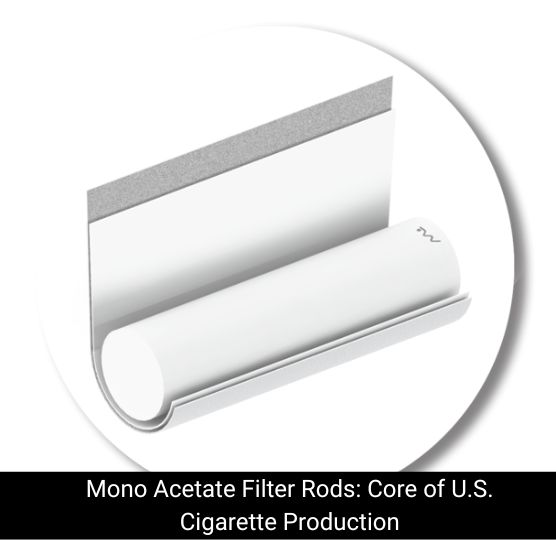
Mono Acetate Filter Rods: Foundation of U.S. Cigarette Production
Mono acetate filter rods remain the backbone of cigarette manufacturing in the United States. Made from cellulose acetate tow, these filters provide balanced filtration, consistent firmness, and reliable draw resistance. Their simplicity and proven performance make them ideal for large-scale production and long production runs.
In the U.S. market, mono acetate filters are widely used in standard cigarette products where stability, cost efficiency, and uniformity are essential. They also serve as the base structure for more advanced multi-segment and customized filter designs.
Dual Filter Rods: Advanced Filtration Control for U.S. Low-Tar Cigarettes
Dual filter rods integrate two distinct filter segments within a single rod, allowing manufacturers to distribute filtration functions across materials. In the U.S. market, dual filter rods are frequently used to achieve enhanced tar reduction while maintaining acceptable draw resistance.
Common segment combinations include acetate with charcoal, which improves gas-phase adsorption, and multi-density acetate, which fine-tunes smoke flow. Dual filter rods are particularly valuable in low-tar cigarettes, where internal filtration control is preferred over excessive paper ventilation.
Recessed Filter Rods: Mouth-End Engineering for Smoke Comfort
Recessed filter rods feature a hollow cavity at the mouth end, designed to soften smoke delivery before inhalation. This recess zone allows smoke to expand slightly, reducing heat and perceived harshness.
In the U.S. market, recessed filter rods are used to enhance mouthfeel and smoking comfort without altering tobacco blends. They are often combined with dual filter structures to deliver both filtration efficiency and smoother smoke presentation.
Capsule Filter Rods: Controlled Flavor Interaction in Select U.S. Segments
Capsule filter rods also known as click filter rods, contain breakable capsules embedded within the filter structure. While capsule cigarettes are more limited in the U.S. compared to some international markets, they remain relevant in select product categories and export-focused lines.
Capsule filter rods allow manufacturers to offer optional flavor activation while maintaining a standard smoking experience when the capsule is not engaged. This flexibility supports niche positioning and differentiated product offerings without disrupting core portfolios.
Flavored Filter Rods: Continuous Aroma Delivery Without Activation
Flavored filter rods deliver aroma through infused filter materials rather than capsules. In the U.S. market, this approach aligns well with regulatory sensitivity, as flavor delivery remains subtle and integrated rather than interactive.
These filters are used to enhance smoke aroma consistency and smoothness across the smoking session. Flavored filter rods also offer advantages in production simplicity and scalability, making them suitable for stable, long-term product lines.
Inner Shaped Filter Rods (Tube Filter Rods): Precision Airflow Control
Inner shaped filter rods -commonly referred to as tube filter rods-feature hollow cores or structured airflow channels within the filter. These designs guide smoke through a defined internal path, reducing turbulence and stabilizing pressure drop.
In the U.S. market, tube filter rods are used to optimize airflow control in low-tar and refined cigarettes. Variations such as circular, star-shaped, or hexagonal inner cores allow manufacturers to fine-tune filtration performance while maintaining cigarette firmness and manufacturing compatibility.
Outer Shaped Filter Rods: Functional Differentiation and Tactile Comfort
Outer shaped filter rods incorporate embossed or grooved external surfaces. In the U.S., outer shaping is typically subtle and function-driven rather than visually bold.
These designs improve grip, enhance mouth-end comfort, and contribute to a premium tactile experience. When engineered correctly, outer shaping does not interfere with airflow or filtration, making it suitable for both premium and mainstream cigarette products.
Customization Options for U.S. Cigarette Manufacturers
Customization is a critical advantage in the U.S. market, where manufacturers must respond to regulatory changes, market segmentation, and production efficiency goals. Filter rod customization options include:
- Length and diameter adjustments
- Tow density and firmness control
- Multi-segment combinations
- Charcoal integration
- Capsule placement and count
- Inner and outer shaping geometries
These options allow brands to develop differentiated products while maintaining consistent performance across high-volume production.
Manufacturing Compatibility and Quality Expectations in the USA
U.S. cigarette manufacturing relies on high-speed, high-precision production lines. Filter rods used in this environment must maintain stable pressure drop, accurate segment alignment, and reliable bonding strength.
Advanced filter rod technologies are engineered to integrate seamlessly with modern cigarette-making machines, ensuring that performance improvements do not introduce operational risks. Consistency across batches is especially critical for brands supplying nationwide distribution.
Regulatory Sensitivity and Filter-Based Adaptability
The U.S. regulatory landscape continues to evolve, placing greater emphasis on measurable performance characteristics. Filter-based solutions allow manufacturers to adapt more flexibly by modifying filtration behavior rather than reformulating tobacco blends.
Advanced filter rod technologies support compliance efforts while preserving smoking experience, making them an essential component of long-term product planning in the U.S. market.
Supporting U.S. Manufacturers with Comprehensive Filter Solutions
Selecting the right filter rod technology requires technical expertise, production insight, and long-term supply reliability. Manufacturers benefit from working with partners who understand both regulatory expectations and operational realities.
Truewell supports U.S. cigarette manufacturers by offering a comprehensive portfolio of mono acetate, dual, recessed, capsule, flavored, inner shaped, and outer shaped filter rods. Through engineering-driven customization, quality control, and export-ready production, Truewell helps brands implement advanced filter solutions with confidence and consistency.
 Email Us Now!
Future Outlook for Cigarette Filter Rod Technology in the U.S.
As the U.S. cigarette market continues to emphasize performance stability and regulatory alignment, demand for advanced filter rod technologies is expected to remain strong. Future developments will likely focus on enhanced airflow precision, improved material efficiency, and deeper integration between filter design and production systems.
Manufacturers that invest in adaptable filter technologies will be better positioned to navigate regulatory changes while maintaining product quality and consumer trust.
Final Perspective: Engineering-Led Filter Solutions for the U.S. Market
In the United States, cigarette filter rods are not merely components—they are engineered systems that shape product performance, compliance readiness, and manufacturing efficiency. From standard mono acetate filters to advanced multi-segment and shaped designs, filter technology remains central to modern cigarette production.
By leveraging advanced filter rod solutions and working with experienced partners, U.S. cigarette manufacturers can achieve consistent performance, regulatory adaptability, and long-term product success.
FAQs on Advanced Cigarette Filter Rod
Why are advanced filter rod technologies important in the U.S. cigarette market?
Advanced filter rods allow U.S. manufacturers to manage tar delivery, airflow, and draw resistance internally, supporting regulatory compliance while maintaining consistent smoking performance across large production volumes.
Which filter rod types are most commonly used in U.S. cigarette manufacturing?
Mono acetate filter rods remain the most widely used, while dual filter rods, recessed filter rods, and inner shaped filter rods are increasingly adopted for low-tar and performance-optimized products.
Are capsule and flavored filter rods suitable for the U.S. market?
Yes, but typically in select or export-oriented segments. Flavored filter rods offer subtle aroma delivery, while capsule filter rods provide optional flavor activation where permitted and strategically appropriate.
How do dual filter rods help control tar and draw resistance?
Dual filter rods distribute filtration across multiple segments, allowing manufacturers to reduce tar levels while maintaining acceptable draw resistance without relying heavily on paper ventilation.
Can advanced filter rods run reliably on high-speed U.S. production lines?
Yes. When properly engineered, advanced filter rods are designed for high-speed manufacturing compatibility, offering stable pressure drop, consistent structure, and reliable performance.
How does Truewell support U.S. cigarette manufacturers?
Truewell provides custom-engineered filter rod solutions, technical consultation, sampling support, and scalable production to help U.S. manufacturers meet performance, compliance, and consistency requirements.